
Partner Cities
Across the world, cities are recognizing the need to develop more just and inclusive urban politics. In response to this, the municipalist movement works to develop bold and original solutions to address democratic deficits in neighborhoods and communities. By collaborating with civil society organizations through public-communitarian partnership, promoting participatory budgeting, and empowering historically marginalized groups to participate in decision-making, municipalism is seeking to reinvigorate democracy from the bottom-up and to democratize the transition to sustainability. While many cities currently pursue municipalism they do so in markedly different ways, opening the opportunity for learning from different experiences and scaling up locally embedded policy innovations.
Amsterdam, Barcelona and Vienna, the three cities studied by MUNEX, are at the forefront of the current municipalist movement. The contrasts between these three cities make them apt for international comparison:
- Barcelona has strong grassroots mobilization but weak government;
- Vienna has a strong government but weak grassroots mobilization;
- Amsterdam takes an intermediary position.
Our main question is whether and how municipalist experiments in bottom-up capacity building work in these different contexts, and how they can be exchanged transnationally.
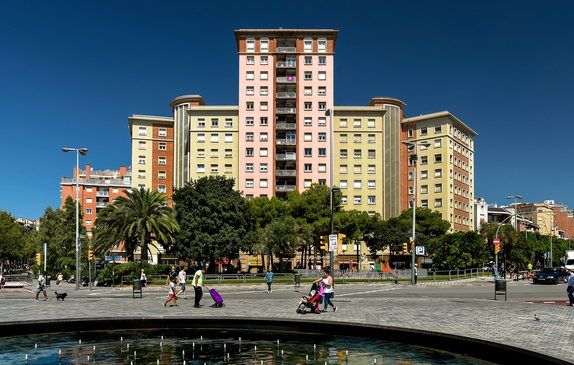
Neighborhoods are the sites par excellence of municipalist innovation. This is where communities are to be empowered and where innovations are to be tested. We therefore focus our transnational research on specific neighborhoods: Margareten in Vienna, Noord in Amsterdam, and Sants in Barcelona. These neighborhoods have vibrant innovation ecosystems of activists, social entrepreneurs, and pioneering policymakers, making them strategic sites for municipalist experiments for sustainable and inclusive neighborhoods.
Amsterdam
Case: Amsterdam Noord
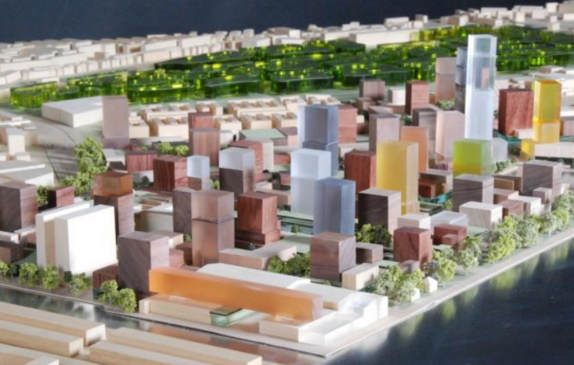
Separated from the rest of Amsterdam through the waters of the IJ, the Northern district of Amsterdam has not only always been physically isolated from the rest of the city, but also culturally. The neighbourhoods in the Old-North were constructed in the 1920s and 1930s as publicly owned garden villages for the working class. Over time, ownership was transferred to housing corporations which are currently selling parts of their stock in this area. The discovery of the North as a site of real estate development should be seen in the wider context. Mainly as a result of immigration of international knowledge workers, Amsterdam’s population continues to grow, while the municipality faced the housing shortage with the ambition to build 52,500 to 70,000 homes before 2025. However, only a third of the newly planned accommodations are affordable rental units.
In apprehension of this ongoing brownfield gentrification of Noord, the network “Red Amsterdam Noord” (Save Amsterdam North) regroups local stakeholders to organize protest and demand political participation. As a result, the city co-planned the Masterplan North with the activists. After the promise of participation, the danger of co-optation has led to scepticism towards Red Amsterdam Noord and put the collaboration on this municipalist project on hold for some time. In 2023, the process was resumed so as to further develop and implement the Masterplan taking the local population’s interests into account.

The progress of the Redevelopment Plan of Old-North in 2022: in red the areas where construction had began, in orange where permits were underway and in blue where the plans weren't definitive.
Urban Living Lab in Amsterdam Noord
Neighbourhood coalitions
The Amsterdam Munex research examines the Northern Approach. After a successful political mobilisation by residents organised in Red Amsterdam Noord, which translates into Save the Northern district of Amsterdam, politicians, civil servants and residents together formulated the following overarching goals for this municipalist process: Together with the local municipality, citizens and other stakeholders develop plans for improving the quality of existing housing, for improving nature, green and public space and for decreasing social inequality by increasing equal opportunities and just outcomes. The living lab in Amsterdam specifically looks at the issue of decreasing social inequality and democratisation through inclusion of citizens.
To prevent double work and overload for participants, we take the municipal process itself as our living lab. Specifically, we here examine the development by the municipality of socalled neighbourhood coalitions in marginalised neighbourhoods of the North since the setup of this development closely matches the outline of our living lab. The residents of the North resist policy and scholarly terms such as 'lab' and 'experiment' which they state make them feel as lab rats in a laboratory. We thus henceforth refer to the living lab as a project. The goals to be achieved through developing the neighbourhood coalitions were formulated at the start of the project by the municipality as follows:
- to regain the trust of the citizens in the local government
- to work together with the residents rather than for them; to structurally change the way that the three groups of stakeholders of civil servants, social workers and residents interact
- to structurally decrease the inequality of opportunities in these neighbourhoods within the next twenty to twenty-five years
- to adjust existing municipal subsidy streams towards the priorities of the residents
In each of the neighbourhoods a series of semi-public meetings took place, as well as a larger get-together for a broader audience. The research followed the development in the Molenwijk closest, hence the findings are most robust for that neighbourhood.
Barcelona
Case: Comunalitats Urbanes and the Reviu portal
In Barcelona like elsewhere, while the public sector has been withdrawing from social service provision in the realms of housing, workforce development, health, and even income and in-kind assistance, community is implicitly, and sometimes explicitly, expected to fill the gaps left as the state retreats. At the same time, Barcelona has been developing new forms of public management through citizen participation in the form of bodies, processes, debates and consultations. A participative governance arose in response to the neighbourhood movement and the demand for more citizen involvement, but it has turned into an oversized and complex, extremely bureaucratic architecture. Comunalitats Urbanes (2022-2024) or “Urban Commonalities” is a public policy program of the Department of Economy and Labor of the Catalan regional government. Its main objective is to boost local economies in neighborhoods and cities, giving impetus to new mutual support projects. The program aims at creating these projects from the perspective of the right to the city, common goods and the social and solidarity economy. With the creation of 22 Comunalitats throughout the Catalan territory being approved, each Comunalitat receives €250,000 over two years to develop its activity.
In contemporary metropolises, one of the biggest yet unattended problems of the housing market is its information asymmetries. Technically a form of market failure, it corresponds to the opposite of what ideal market models look like in textbooks. In a global city like Barcelona, information about the housing supply is mostly shaped and provided by those that manage the supply, i.e. real estate brokers and to a lesser extent landlords. Reviu is a bottom-up process of participation which emerges both from a need expressed by tenants and by an interest from actors close to the administration. Like the Comunalitats, it is a paradigmatic municipalist experiment aiming at democratizing the city by exploring a public-community alliance based on a collaboration between a citizen initiative and municipal institutions. While the case study will have in the neighborhoods of Sants and Eixample its hotspots (where community work will be done to make the portal grow), its online nature endows it with the potential to grow at city-wide level.

Laia Forné, co-founder of the La Hidra cooperative, and Yayo Herrero at a Comunalitats Urbanes meeting.
Urban Living Labs in Sants
Developing reciprocity metrics
The first living lab has been co-designing and co-producing different meetings and workshops in Sants with 22 civil society organizations and activist networks -including cooperation partner Coopolis-, neighborhood inhabitants, and key members of the local and regional government. This has been done in the context of a public policy program of the Catalan regional government known as Comunalitats Urbanes (2022-2024) or “Urban Commonalities”. The main aim of this process has been to develop new indicators and metrics that allow both neighborhood communities and the local state to evaluate practices of mutual support and reciprocity, thus promoting a public-communitarian partnership.
Addressing housing transparency
After an initial diagnosis, the research team found it necessary to launch this second living lab specifically centered around the promotion of public-communitarian partnerships in the sphere of housing. Regular meetings have been held with neighborhood inhabitants, civil society organizations, software developers and key members of the municipality (Sants and Citizen Participation Department, and Housing Department), to co-create an online housing portal: a cooperative start-up initiative that seeks to tackle the housing crisis by reducing democratic deficits and asymmetries produced by the market, and fostering reciprocity, transparency and well-being among residents.

Jaime Palomera and the Advisory Board at the Reviu living lab organized at IDRA.
Vienna
Case: The Wiener Klimateam
Regarding Citizen Participation, Vienna's top-down and interventionist policy approach is an enduring legacy of the long Social-Democratic municipal government, which has provided limited support to civic involvement in public affairs. While Urban Renewal Offices "Gebietsbetreuung Stadterneuerung" and Neighborhood Management Offices "Stadtteilmanagement" provide local residents with opportunities for engaging in the planning processes, these instruments lack a policy framework to ensure that participation has a meaningful outcome. Vienna’s first participatory budgeting was launched in Margareten in 2017 with the limited resources of the district council "Bezirksvertretung" only. The Wiener Klimateam at the city level began in 2020, which targeted climate change adaptation and mitigation in three pilot districts. This new governmental institutionalisation implies far greater financial resources and institutional capacities.
The Wiener Klimateam offers a novel example to study the current trend of participatory budgeting in European cities. First, Vienna’s top-down approach features a strong presence of organized groups in the public sector who play an active role throughout the process, which makes for a ‘corporatist’ model of participatory budgeting unique in Europe. Second, Vienna’s budgeting design – combining online and offline tools at different stages – contributes to building knowledge about such a hybrid form of participatory budgeting.
Urban Living Lab in Margareten
Conducting Participatory Monitoring and Evaluation
The urban living lab (ULL) design of the Vienna case aims at conducting Participatory Monitoring and Evaluation (PM&E) for collaborative assessment of Wiener Klimateam’s first pilot year in the district of Margareten. Our ULL design foresees a transformative knowledge exchange between institutional and non-institutional actors that connects grassroots innovation with existing institutional opportunity structure. This represents the basis for building an epistemology of emancipation, which should emerge from upscaling grassroots mobilization as an organized political agency, contributing to kick-off institutional learning processes.
Building on the key defining characteristics of ULL in existing literature, we set three key objectives to achieve this primary aim: empowerment; innovation; and effectiveness. In order to achieve these objectives, we build three key components into our ULL design: geographical embeddedness; user involvement; and iterative learning, which are incorporated into three key stages of our ULL process: co-plan; co-develop; and co-implement. We apply different PM&E approaches in each stage, which is followed by specific data collection methods.

Visualising the Workshop's Outputs
The goal of this workshop on April 21, 2023 was to co-plan the next evaluation phase by formulating a ‘Theory of Change’ behind the five Wiener Klimateam projects in the district of Margareten: the Repair Café, Climate Day, Superblock, Shared Zone, Facade Greening. It aimed to discuss the short- and mid-term outcomes and long-term impacts that are necessary to achieve the stated objectives of Wiener Klimateam. Those are Democracy Development, Governance Innovation, Social Justice, Climate Protection. This evaluation model is intended to serve as a foundation of the following co-creation phase, which develops performance indicators and their measures.
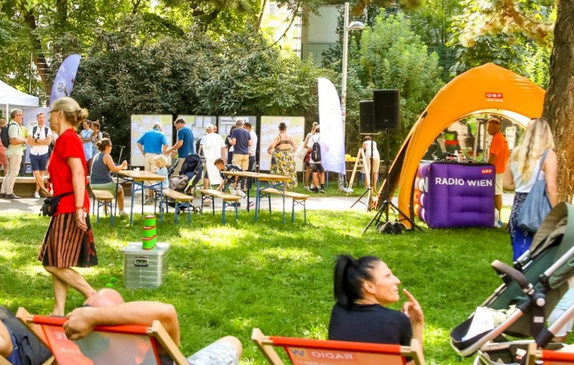
The first ULL workshop was organized at the Kulturhaus Brotfabrik on February 07, 2023 and brought together stakeholders in the Margareten district. The agenda comprised Inputs from University of Vienna researchers, and team members from project partner Caritas, one Group Discussion session and a final Plenary Discussion. Motivations, Expectations, Experiences and Improvements from first Wiener Klimateam were communicated among the local stakeholders, which was used to then prepare the evaluation activities of the ULL.